No More Shattered Shells, No More Frustration**
We’ve all been there:
You carefully lower eggs into water, time them just right, cool them gently…
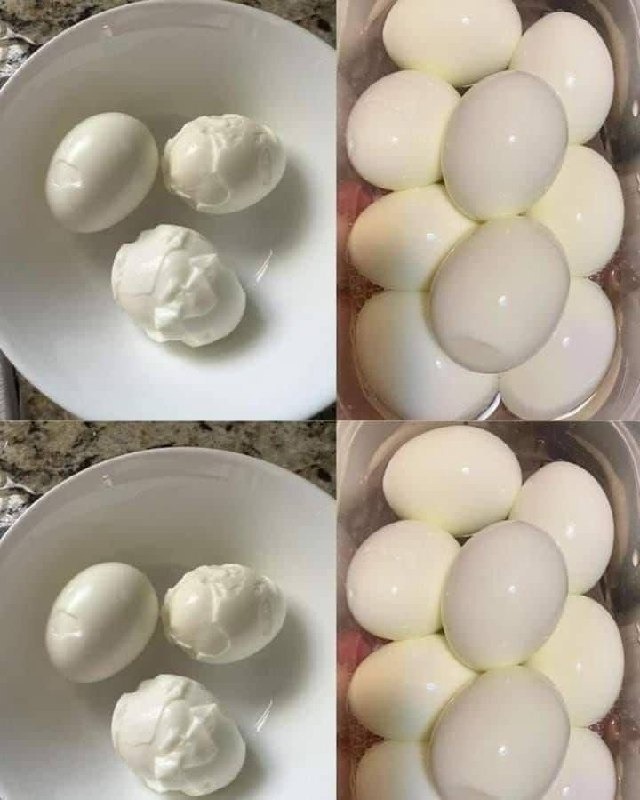
Then you tap, you roll, you peel—and half the white comes off with the shell.
What’s left looks less like a deviled egg, more like a lunar landscape.
The truth? It’s not you.
And it’s not even the eggs—not really.
It’s how you cook them.
Let’s uncover the gentle science—and the simple, time-tested trick—that turns peeling from a battle into a breeze.
Why Fresh Eggs Fight Back
Here’s the quiet truth most recipes don’t tell you:
The fresher the egg, the harder it is to peel.
Why?
In very fresh eggs, the egg white (albumen) is slightly acidic, causing it to cling tightly to the inner membrane of the shell—like tissue paper stuck to glass.
As eggs age (7–10 days), their pH rises, and that bond loosens.
Suddenly, the shell slips off like a silk glove.
But what if your eggs are farm-fresh? Or from the farmers’ market?
Good news: You don’t need to wait.
There’s a kinder, smarter way.
The “Hot Start + Ice Shock” Method: Foolproof & Gentle
(Tested by home cooks, chefs, and food scientists alike)
This isn’t about vinegar baths or poking holes.
It’s about respecting the egg’s natural rhythm—heat, rest, and cool—so the shell lets go on its own.
What You’ll Need
- Eggs (yes—even farm-fresh ones!)
- A saucepan with a tight-fitting lid
- A bowl of ice water (½ ice, ½ cold water)
- A slotted spoon
- Patience (just 15 minutes of it!)
Step-by-Step: The Gentle Way
1. Start in Boiling Water (Not Cold!)
→ Bring a pot of water to a full, rolling boil.
→ Gently lower eggs in with a slotted spoon (a splash of vinegar can help prevent cracks, but skip it if you dislike the taste).
Why it works:
The sudden heat sets the outer layer of the white just enough to create a micro-gap between the membrane and shell—like loosening a lid before you twist.
2. Cover, Rest, and Resist the Urge to Boil
→ Return to a gentle simmer for 30 seconds—just to reheat.
→ Remove from heat. Cover. Let sit:
• Medium eggs: 9 minutes
• Large eggs: 10 minutes
• Extra-large: 12 minutes
Why it works:
Steaming-in-place cooks the egg evenly—no rubbery whites, no green yolks, and no tight membrane grip.